

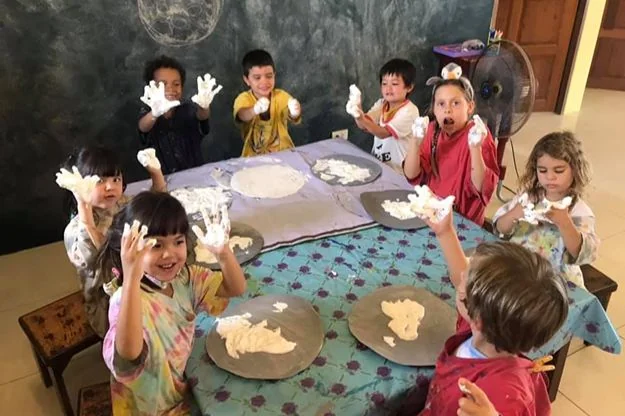
A holistic approach to early childhood education recognises that young children develop in connected ways. Language, thinking, movement, emotions, confidence, creativity and relationships influence one another throughout the day.
When a child builds a tower, for example, the experience may involve counting, comparing sizes, planning, problem-solving, hand-eye coordination and communicating with other children. What looks like one simple activity can support several areas of development at the same time.
For parents, the important question is therefore not only what children are being taught. It is also how the learning experience supports the child as a whole.
What Is a Holistic Approach to Early Childhood Education?
A holistic approach does not divide a child’s development into completely separate subjects. Instead, teachers consider how different skills and experiences work together.
This does not mean removing structure or overlooking early academic learning. Literacy, numeracy and logical thinking remain important. However, they are developed alongside communication, physical coordination, creativity, emotional security, social understanding and growing independence.
The aim is not to rush children towards isolated outcomes. It is to build strong, age-appropriate foundations that help children participate confidently in learning.
The National Association for the Education of Young Children explains that developmentally appropriate practice supports children across all areas of development while recognising their individuality, strengths and personal context.
How Different Areas of Learning Connect
Young children rarely use just one skill at a time.
During a storytelling activity, a child may listen, remember events, learn new vocabulary, interpret emotions and predict what might happen next. If the child then draws a scene from the story, the experience also involves creativity, decision-making, pencil control and hand-eye coordination.
A construction activity can involve counting, comparing, balance, spatial awareness, cooperation and problem-solving. Imaginative play may involve language, negotiation, memory and understanding another person’s point of view.
A holistic approach to early childhood education makes these connections visible. Teachers can plan meaningful experiences while observing which skills each child is using and what encouragement may be helpful next.
Language, Literacy and Numeracy
Strong early literacy begins with more than recognising letters. Children also need vocabulary, listening skills, sound awareness, an interest in stories and confidence in expressing ideas.
Similarly, early numeracy includes more than repeating numbers. Children build mathematical understanding when they sort, compare, count, recognise patterns, estimate quantities and solve practical problems.
English-intensive learning can provide children with frequent opportunities to hear and use English through stories, songs, conversation, play, routines and shared activities. These natural interactions help language become part of meaningful communication rather than only something practised in isolation.
Parents can learn more about how these areas are brought together on the Shining Stars curriculum page.
Social and Emotional Development
Children learn more easily when they feel secure, understood and comfortable participating.
Early childhood is an important time for learning how to join an activity, wait for a turn, communicate a need, manage disappointment and recover from small disagreements. These abilities develop gradually through experience and adult guidance.
Teachers can support children by naming emotions, modelling respectful language and helping them consider possible solutions. A disagreement over materials can become an opportunity to practise listening, explaining and negotiating.
Confidence also grows through manageable challenges. When children are encouraged to try, make mistakes and attempt a different solution, they begin to see themselves as capable learners.
Physical Development Supports Learning
Physical development is closely connected to many everyday learning tasks.
Gross motor experiences support balance, coordination, body awareness and confidence in movement. Fine motor activities strengthen the smaller muscles used for drawing, manipulating objects, fastening clothing and eventually writing.
Activities involving construction materials, drawing, threading, puzzles, modelling materials and age-appropriate tools can develop coordination and hand control while also supporting concentration and problem-solving.
A holistic learning environment therefore recognises movement and physical development as important parts of a child’s overall progress—not as activities entirely separate from thinking and learning.
Creativity, Curiosity and Problem-Solving
Creativity allows children to explore ideas, make choices and express their understanding in different ways.
An open-ended activity may not produce identical results for every child. That is part of its value. Children can experiment, change their minds, combine materials and find their own solutions.
Teachers can extend this learning with questions such as:
- What do you notice?
- What could you try next?
- Why do you think that happened?
- Is there another way to solve it?
- Can you explain your idea?
These conversations support vocabulary, reasoning and confidence without taking control of the child’s work.
A holistic approach to early childhood education values the thinking behind an activity, not only the finished result.
Individual Attention in a Holistic Approach to Early Childhood Education
Children of the same age can have different interests, strengths, communication styles and levels of confidence.
Individual attention helps teachers notice these differences. One child may need a gentle invitation to join a group, while another may need a more challenging question. One may benefit from a demonstration, while another needs time to continue experimenting independently.
Small classes can create more opportunities for close observation, conversation and carefully timed guidance. However, the number alone is not enough. What matters is whether teachers genuinely know the children and use their observations to support participation and progress.
Parents can learn more in our article about why small classes matter in early childhood education.
What Holistic Learning Looks Like in Practice
During a preschool visit, parents can look for evidence that different areas of development are being supported together.
Useful signs include:
- Children actively exploring instead of only watching an adult
- Teachers speaking with children and listening to their responses
- Opportunities to move, create, build, talk and solve problems
- Literacy and numeracy appearing naturally within meaningful activities
- Teachers guiding children without immediately taking over
- Children being encouraged to explain ideas and make choices
- Learning materials being used in different ways
- A caring atmosphere in which children appear comfortable participating
A visually impressive classroom alone does not prove that holistic learning is taking place. The strongest evidence is found in the interactions between teachers, children, activities and ideas.
Questions Parents Can Ask
When visiting a preschool, consider asking:
- How do activities support more than one area of development?
- How are literacy and numeracy included in play and everyday learning?
- How do teachers support children with different interests and confidence levels?
- How are communication and social skills developed?
- What opportunities do children have for movement and physical development?
- How do teachers encourage creativity and problem-solving?
- How is each child’s progress observed and shared with parents?
The answers should include clear examples from everyday learning rather than only broad promises.
Supporting the Whole Child
A holistic approach to early childhood education does not choose between academic learning, creativity, confidence, communication or physical development. It recognises that these areas strengthen and support one another.
For families considering a preschool or kindergarten in Phuket, the most useful evidence is found in what children experience each day: how they communicate, explore, think, move, create and interact with others.
Families from Kamala and nearby Surin, Bang Tao and Patong are welcome to visit Shining Stars School Kamala and experience our learning environment in person. kindergarten in Phuket are welcome to contact us to learn more or arrange a school visit.
Learn ★ Play ★ Grow
Looking for a preschool or kindergarten in Phuket?
Shining Stars School Kamala provides English-intensive, play-based learning for children ages 2–7 in a caring environment with individual attention.
Contact Shining Stars