

Screens are part of everyday family life. Phones, tablets, televisions and computers can be useful, but too much screen time can replace experiences that are especially important during early childhood.
Young children learn through movement, conversation, play, exploration and interaction with other people. The goal does not necessarily have to be removing screens completely. A more practical approach is to create a healthy balance so that screens do not take the place of sleep, physical activity, creative play and family interaction.
Why Reducing Screen Time Matters in Early Childhood
The years from ages two to seven are an important period for physical, social, emotional, language and cognitive development.
Children develop essential skills through real experiences:
- Building with blocks develops planning and coordination.
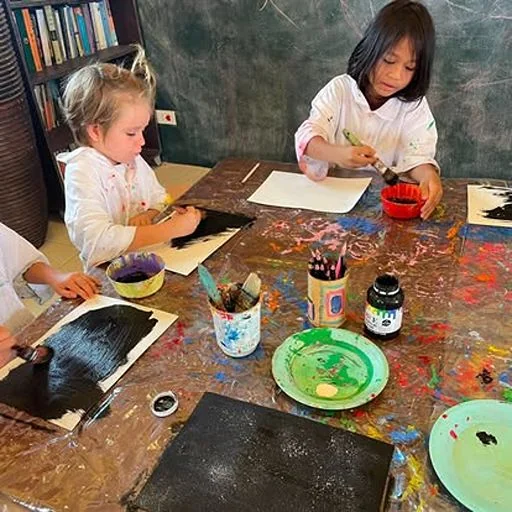
- Drawing and painting encourage creativity and fine motor control.
- Outdoor play supports movement, balance and physical confidence.
- Playing with other children develops communication, cooperation and social skills.
- Books and storytelling encourage language, imagination and early literacy.
When screens occupy a large part of a child’s free time, there may be less time available for these valuable experiences.
The useful question is therefore not only, “How much screen time does my child have?” Parents can also ask:
“What activities is screen time replacing?”
Replace Screen Time Rather Than Simply Removing It
Turning off a tablet without offering another activity can quickly become a daily struggle.
Reducing screen use is often easier when children have something interesting to do instead. Simple alternatives include:
- Drawing, colouring and painting
- Building blocks and construction toys
- Puzzles and matching games
- Books and storytelling
- Music and dancing
- Pretend play
- Water or sand play
- Helping with simple household activities
- Outdoor games
- Nature walks
- Playing with other children
These activities do not need to be complicated or expensive. For young children, ordinary experiences can provide meaningful opportunities for learning.
Create Predictable Screen-Time Routines
Clear routines help children understand when screens are available and when they are not.
Instead of deciding each time a child asks, families can establish regular screen-free parts of the day. For example:
- No phones or tablets during meals
- No screens before preschool or kindergarten
- Devices are turned off before the bedtime routine
- Screens are used only after active play or another planned activity
- Devices remain outside the bedroom
Consistency is important. When children understand the routine, turning off a device becomes less of a negotiation and more of a normal part of family life.
Keep Family Meals Screen-Free
Family meals offer valuable opportunities for conversation.
Young children develop language by listening, answering questions, telling stories and participating in everyday discussions. A screen-free meal gives children more opportunities to communicate with parents and siblings.
Parents can encourage conversation with simple questions such as:
- What did you enjoy today?
- What made you laugh?
- What was difficult?
- Who did you play with?
- What would you like to do tomorrow?
Questions like these encourage children to remember events, organise their thoughts and express themselves.
Encourage Independent Play
Parents sometimes use screens because they need time to cook, work or complete household tasks. This is understandable.
Children can gradually learn to play independently without needing constant adult entertainment. Keeping a small selection of accessible activities ready can help. These might include blocks, crayons, books, puzzles, toy animals, dolls or simple craft materials.
Children do not need to be entertained every minute. Having time to choose what to do can encourage imagination, problem-solving and independence.
Start with short periods of independent play and gradually extend them as the child becomes more comfortable.
Make Outdoor Play Part of the Daily Routine
Outdoor activity is one of the simplest alternatives to screen time.
Running, climbing, balancing, throwing, digging and exploring support coordination, strength and physical confidence. Outdoor environments also provide changing sights, sounds, textures and experiences that children cannot receive from a screen.
For families living in Kamala and surrounding areas of Phuket, even a short outdoor period can become a helpful part of the daily routine.
The activity does not need to be organised. Walking, playing with a ball, collecting leaves or simply exploring outside can give children opportunities to move, observe and ask questions.
Be Aware of Adult Screen Habits
Young children learn by watching the adults around them.
If phones are constantly present during meals, conversations and family activities, children naturally learn that screens deserve continuous attention.
Parents do not have to stop using their devices. However, intentionally putting phones away during selected parts of the day demonstrates the habits parents want their children to develop.
Simple changes can include:
- Keeping phones away from the dining table
- Avoiding checking notifications during conversations
- Creating a shared place where family devices are left
- Joining children in reading, drawing or outdoor play
- Explaining when a device is being used for work or another practical purpose
Children are more likely to accept family screen rules when they see adults following them too.
Choose Screen Content Carefully
Reducing screen time does not mean that every use of technology is harmful.
When children use screens, parents can consider the quality of the content, why it is being used and whether an adult is involved.
Age-appropriate educational programmes, video calls with family and carefully selected creative activities can be different from continuous passive viewing.
Parents can make screen use more interactive by watching with their child, asking questions and connecting the content to real experiences.
For example, after watching something about animals, a child could draw a favourite animal, move like it, describe where it lives or find it in a book.
The World Health Organization encourages families to replace prolonged sedentary screen use with active play while also protecting sufficient sleep. Its guidance for children under five also recommends reading and storytelling with a caregiver during quiet periods. You can read the WHO guidance on physical activity, sedentary behaviour and sleep.
Avoid Using Screens as the Only Answer to Boredom
Boredom is not always a problem that adults need to solve immediately.
When children have some time without ready-made entertainment, they may begin inventing games, building, drawing, exploring or creating imaginary situations. This process can support creativity and independence.
If a child says, “I’m bored,” parents can offer a limited choice rather than immediately providing a screen:
- Would you like to draw or build something?
- Shall we read a book or play outside?
- Would you like to help me prepare the table?
- Can you invent a game using these toys?
Sometimes the opportunity to decide what to do is itself a valuable learning experience.
Reduce Screen Time Gradually
Families do not have to make dramatic changes overnight.
A sudden ban may be difficult to maintain, especially when screen use is already part of the daily routine. Smaller, consistent changes are often more manageable.
A family might begin by:
- Making one meal each day screen-free.
- Turning devices off before bedtime.
- Introducing a regular outdoor activity.
- Preparing independent-play materials in advance.
- Choosing one part of the day for shared reading.
- Using a timer or clear warning before screen time ends.
Parents can acknowledge that stopping is difficult while still keeping the boundary clear: “I know you want to continue. Screen time is finished now. You can choose blocks or drawing next.”
Real Experiences Support Early Learning
At Shining Stars School Kamala, children learn through active participation, play and meaningful real-world experiences.
Creative projects, storytelling, books, movement, conversation and interaction with teachers and classmates give children opportunities to develop communication, confidence, independence, physical coordination and social skills.
Small classes allow teachers to interact directly with children, notice their individual needs and involve them in purposeful activities throughout the day.
Our curriculum combines structured early learning with opportunities for children to explore, create, communicate and make choices.
Small Changes Can Make a Meaningful Difference
Reducing screen time is not simply about removing technology. It is about creating more room for the experiences young children need:
Conversation, movement, imagination, relationships, exploration and play.
One screen-free meal, an outdoor routine, a story before bed or more opportunities for independent play can be a practical starting point.
Changes do not have to be perfect to be worthwhile. Clear routines and realistic alternatives can help families build a healthier balance over time.
Looking for an Active Learning Environment in Phuket?
Shining Stars School Kamala is a progressive preschool and kindergarten for children ages 2–7.
Located in Kamala, Phuket, we welcome local, expatriate and international families, including families living in Kamala, Surin, Bang Tao, Patong and surrounding areas.
Our approach focuses on small classes, individual attention, English-intensive learning and positive, hands-on experiences that help children learn with confidence.
Learn ★ Play ★ Grow
Looking for a preschool or kindergarten in Phuket?
Shining Stars School Kamala provides English-intensive, play-based learning for children ages 2–7 in a caring environment with individual attention.
Contact Shining Stars