
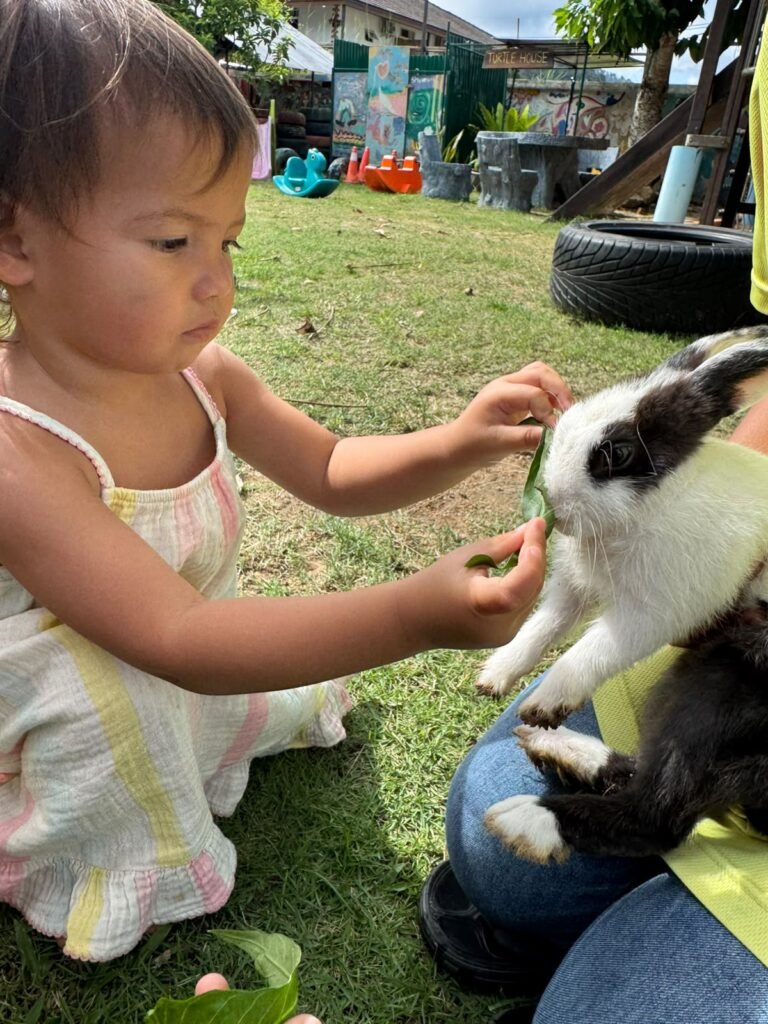
Animals can create powerful learning opportunities for young children. At Shining Stars School Kamala, interaction with animals is incorporated into children’s everyday experiences because learning is often most meaningful when children can see, touch, observe and participate.
For children aged 2–7, a small animal can become the starting point for conversations about nature, responsibility, emotions, communication and the world around them. These experiences are also an important part of our early childhood curriculum, where children learn through meaningful, hands-on experiences.
Learning Empathy and Kindness
Young children are still learning how their actions affect others.
When they interact with rabbits, tortoises and other animals, they begin to understand that living things have needs and must be treated gently.
A teacher can guide a child to stroke an animal carefully, wait patiently, offer food correctly or recognise when an animal needs space.
These simple experiences help children practise kindness and consideration in a very real way.
Developing Responsibility
Animals provide children with an easy-to-understand introduction to responsibility.
They begin to recognise that animals need food, clean water, suitable surroundings and regular care.
Even very young children can participate in simple supervised activities such as helping prepare food, observing whether an animal has enough water or learning why its environment needs to remain clean.
Responsibility becomes something children experience rather than something that is simply explained to them.
Encouraging Curiosity and Observation
Animals naturally attract children’s attention.
Why does a tortoise have a shell?
What does a rabbit eat?
Why does one animal move quickly while another moves slowly?
These questions provide opportunities for teachers to introduce vocabulary, basic science concepts and discussion.
Children learn to look more closely, notice differences and ask questions about what they see.
This type of curiosity is an important part of early learning.
Supporting Language and Communication
Real experiences give children something meaningful to talk about.
A child who has just fed a rabbit or held a tortoise has an immediate reason to describe what happened, explain how the animal felt, remember what it ate or tell another child about the experience.
Teachers can introduce new words naturally during these moments.
Instead of learning vocabulary in isolation, children connect words with something they have actually experienced.
Building Confidence
For some children, approaching an unfamiliar animal can initially feel challenging.
With calm supervision and encouragement, children can participate at their own pace.
One child may initially prefer simply to watch. Later, that same child may feel comfortable touching, feeding or holding the animal.
These small achievements can help children become more confident when encountering new experiences.
Learning Patience and Self-Control
Animals do not always behave according to a child’s expectations.
Children may need to wait for their turn, move slowly, remain quiet or allow an animal to approach them first.
These situations create natural opportunities to practise patience and self-control.
The lesson becomes immediate: moving too quickly may frighten the animal, while being calm and gentle creates a better interaction.
Connecting Learning With the Natural World
Children increasingly experience much of the world through screens, books and pictures.
Direct interaction with living things offers something different.
They can observe how an animal moves, feel different textures, notice how it reacts and understand that animals are living creatures rather than simply pictures in a book.
These experiences help make nature and science more tangible for young children.
Families looking for more information about supporting children’s development can also explore our parent resources.
Learning Together
Animals can also create shared experiences between children.
Children watch one another, exchange observations and talk about what they are doing.
One child may explain how to hold a tortoise carefully while another notices what it is eating.
These moments encourage cooperation, communication and learning from one another.
Safe and Respectful Interaction Matters
Children’s interaction with animals should always be carefully supervised.
Teachers need to consider the wellbeing of both the children and the animals, including appropriate handling, hygiene and giving animals sufficient quiet time.
The aim is not simply for children to touch an animal. It is to teach them how to interact with another living creature respectfully.
Learning Through Real Experiences
At Shining Stars School Kamala, we believe young children learn particularly well when they are actively involved.
Animals give children opportunities to observe, question, communicate, care and discover.
What may appear to be a simple moment—feeding a rabbit or carefully holding a tortoise—can involve language, science, social development, confidence, responsibility and empathy at the same time.
That is what meaningful early learning often looks like: real experiences that children can understand, remember and build upon.
Parents who would like to experience our learning environment can find more information about admissions and school visits.
Learn ★ Play ★ Grow
Looking for a preschool or kindergarten in Phuket?
Shining Stars School Kamala provides English-intensive, play-based learning for children ages 2–7 in a caring environment with individual attention.
Contact Shining Stars