

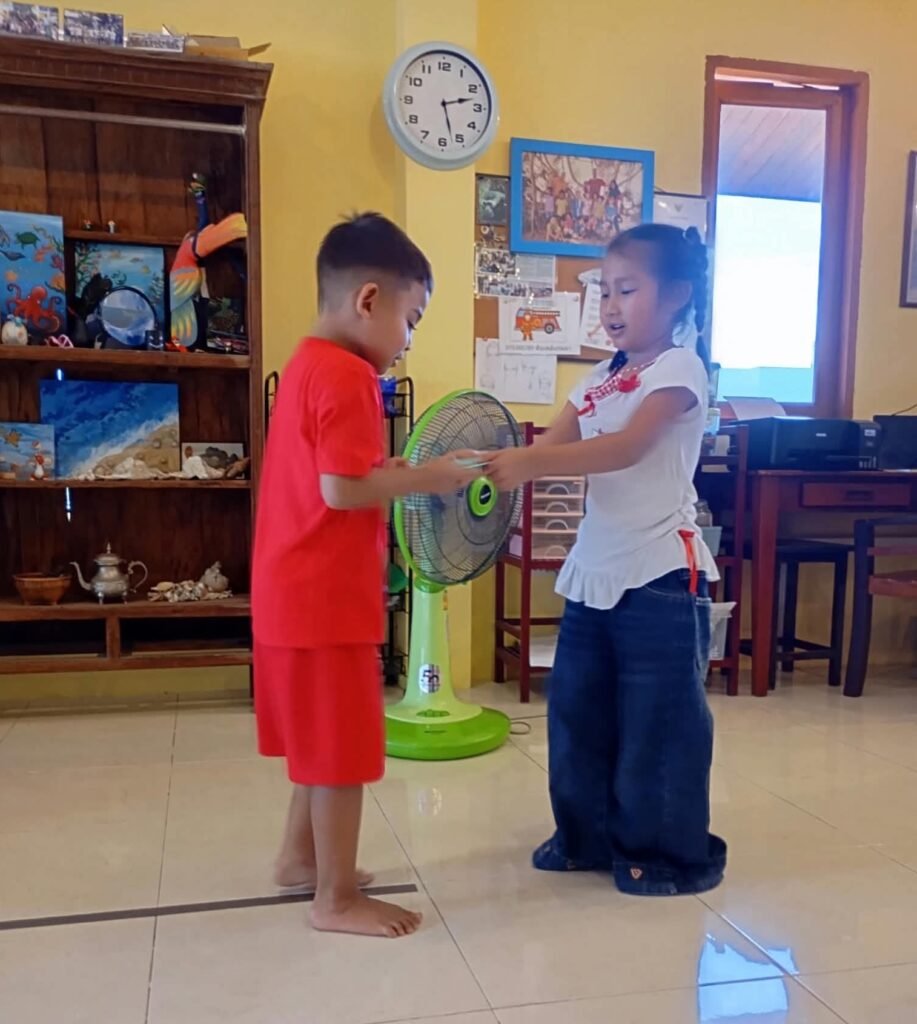
Wanting to join other children and knowing how to join are different things. A child may stand nearby, reach for a toy or interrupt a game because they are still working out what to say and do. Helping children make friends begins with making those small social steps easier to understand.
For children aged 2–7, friendship can involve plenty of practice, pauses and adult support. Being quiet, needing time to observe or preferring one playmate does not make a child less friendly.
Give children words they can use
“Can I build beside you?” or “Could I have a turn when you finish?” gives a child something more concrete than “Go and make friends.” Practise a simple phrase together when there is no pressure to use it immediately.
For a child who is not yet comfortable speaking, you can help them point, offer an object or stand alongside you while you introduce the idea. Joining in does not always begin with a confident sentence.
Raising Children Network offers further practical ideas in its guide to preschool friendships.
Make room for everyone’s needs
Two children can want the same thing at the same time. Instead of quickly deciding who is being “good,” name the problem: “You both want the truck.” Then help them consider a workable next step, such as taking turns or finding another way to play together.
Sharing is not the same as having to surrender something immediately. Children also need help expressing boundaries and respecting another person’s answer. An adult can remain nearby while they practise.
Try a small shared task at home
With a sibling, cousin or visiting friend, suggest something that has room for two contributions: choosing pictures for a pretend menu or making a simple construction together. These are home ideas, not tests of social ability.
Keep the task brief and flexible. One child might choose while the other places an item. If interest fades, it is fine to finish. Notice a specific moment of cooperation: “You waited while she explained her idea.”
For more ways to practise these skills together, explore NAEYC’s ideas for building social and emotional skills at home.
Friendship is part of learning
WE brings relationships into the ME–WE–US–ALL OF US Positive Learning Experiences Journey at Shining Stars School Kamala. The everyday work of asking, listening and finding a way forward matters alongside other learning.
After a difficult interaction, a gentle “What could we try next time?” can be more useful than a lecture. Friendship does not require getting every moment right. It grows through supported opportunities to reconnect.
Discover our approach for ages 2–7 on our curriculum page.
Learn ★ Play ★ Grow
Looking for a preschool or kindergarten in Phuket?
Shining Stars School Kamala provides English-intensive, play-based learning for children ages 2–7 in a caring environment with individual attention.
Contact Shining Stars